
Is an online acne clinic regulated in the UK? What to check before booking
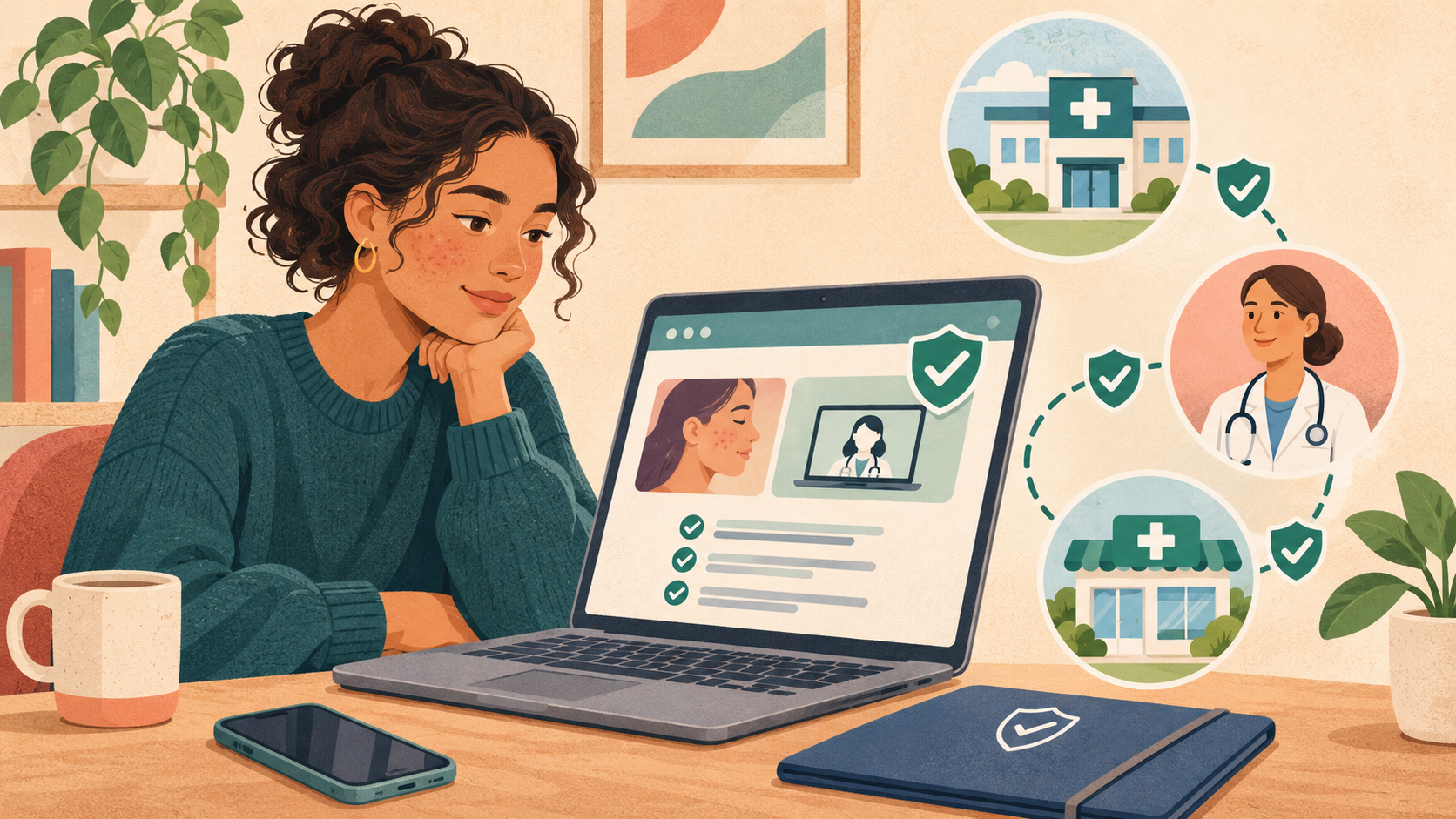
An online acne clinic may be regulated, but there is no single badge that answers every safety question. The healthcare provider, the clinician and any pharmacy involved can have different regulators. The correct service regulator also depends on where the provider is based and how it operates.
Before paying or sharing photographs, check the clinic's legal name, location, regulator and clinical process on official registers. A polished website or testimonials do not provide the same assurance.
Start with the healthcare provider
In England, the Care Quality Commission (CQC) regulates providers that deliver regulated healthcare activities, including many online consultation and prescribing services. Some business models fall outside its scope, so the absence of a CQC entry is not automatically proof that a website is unlawful. The clinic should explain which regulator applies.
The other UK nations have their own service regulators:
Healthcare Improvement Scotland (HIS) in Scotland
Healthcare Inspectorate Wales (HIW) in Wales
the Regulation and Quality Improvement Authority (RQIA) in Northern Ireland.
Regulation usually follows the provider’s location and legal model, not simply where the patient lives. Check its address and legal name, then search the relevant regulator’s official register. A trading name may differ from the name on the regulatory record.
Check the individual clinician separately
A clinic’s registration does not replace professional registration. If a doctor will assess or prescribe, search the General Medical Council (GMC) register and confirm that they hold a licence to practise. Other professionals have their own registers.
Registration confirms a professional’s current status; it does not mean that every registrant has the same dermatology experience. A credible acne service should make clear who reviews your case, their professional role and whether the planned treatment is within their competence. Be cautious if you cannot identify the responsible clinician before treatment is recommended.
If medicines are supplied, check the pharmacy too
The prescribing clinic and dispensing pharmacy may be separate organisations. In Great Britain, the General Pharmaceutical Council (GPhC) maintains registers for pharmacies, pharmacists and pharmacy technicians. Northern Ireland has a separate pharmacy regulator, the Pharmaceutical Society of Northern Ireland.
An online service should identify the pharmacy that supplies medicines and provide its address, registration details and contact route. Search the official register rather than relying on a logo. The GPhC also publishes many pharmacy inspection reports.
The clinic decides whether a prescription is clinically appropriate; the pharmacy checks and dispenses it. Paying for a consultation should never guarantee a particular prescription.
Seven practical checks before you book
Find the legal identity. Look for the provider’s full name, UK address, contact details and terms.
Search the service regulator. Match the name and address on the official CQC, HIS, HIW or RQIA register. Read the registration details and any inspection report rather than relying only on a homepage logo.
Verify the clinician. Use the appropriate professional register and confirm current registration or licence. Check who takes responsibility for diagnosis, prescribing and follow-up.
Understand the consultation. You should be asked about severity, scarring, previous treatments, medicines, allergies, pregnancy or breastfeeding where relevant, and wellbeing.
Check the limits of online care. The service should explain when photographs are insufficient, how it arranges or recommends an in-person examination and what happens if symptoms are urgent.
Clarify the full cost. Ask whether prescriptions, medicines, blood tests, follow-up or letters cost extra.
Read the complaints and privacy information. There should be a clear route for clinical questions, side effects, complaints and data concerns, including how photographs and records are stored and shared.
What should a safe acne assessment include?
A clinician should assess the diagnosis and severity rather than simply accept the patient’s preferred treatment. They should ask what has been tried, whether it was used correctly and for long enough, and whether another diagnosis or urgent referral is possible.
The plan should cover realistic timescales, side effects, pregnancy precautions where relevant, and when treatment will be reviewed. It should also explain what to do if acne worsens or affects mental health. Same-day medical assessment is needed for a sudden severe acne eruption accompanied by fever, joint pain or feeling very unwell.
Be cautious about guaranteed prescription-only medicines
UK advertising rules prohibit promoting prescription-only medicines to the public. Clinic websites may provide balanced factual information on inner pages, but should promote an assessment rather than present a named medicine as a product to buy.
Promises of “guaranteed treatment”, countdown discounts, “add to basket” prescribing or a medicine offered before a meaningful assessment are warning signs. This is particularly important with oral isotretinoin. It is reserved for suitable severe or scarring acne after appropriate treatment has not worked, and it requires specialist expertise and safety monitoring. Current MHRA guidance says the first Lead Prescriber appointment must be in person; later reviews may be remote when clinically appropriate. Mental health, sexual health and pregnancy-prevention requirements must also be addressed.
Frequently asked questions
Does a CQC logo prove that an online clinic is safe?
No. Search the live CQC register, confirm the record belongs to the same provider and read its scope and inspection information. Check the clinician and pharmacy separately.
Does every UK online clinic need to be registered with the CQC?
No. The CQC covers England and registration depends on where and how the service operates. Providers elsewhere in the UK may fall under HIS, HIW or RQIA, and some business models may be outside a particular regulator’s scope. The provider should explain its position clearly.
Is a doctor’s GMC registration enough?
It is essential for a UK doctor, but it is only one layer. You should also check the healthcare provider, any dispensing pharmacy, the clinician’s relevant experience and the service’s follow-up arrangements.
Can registration guarantee that isotretinoin will be suitable?
No. Regulation supports safer systems; it cannot determine the right treatment before an individual clinical assessment. Many people need standard topical, antibiotic or hormonal options instead, and some require in-person investigation or another diagnosis.
Taking the next step
If acne is persistent, painful, scarring or affecting your wellbeing, a structured assessment can clarify the diagnosis and appropriate options. The mySkinDoc remote consultation lets you submit your history and clear photographs for clinical review. Online assessment does not guarantee a prescription and may identify that an in-person appointment, GP review or urgent care is more appropriate. You can also read our guide to online versus in-person acne consultations.
References
Care Quality Commission. Choosing an online healthcare service. Updated 14 April 2026.
Care Quality Commission. Online primary care services. Updated 9 March 2026.
General Medical Council. Search the medical register.
General Pharmaceutical Council. Guidance for registered pharmacies providing services at a distance. February 2025.
MHRA. Advertise your medicines.
ASA/CAP. Prescription-only medicines on websites.
MHRA. Isotretinoin: changes to prescribing guidance and additional risk minimisation measures. 22 January 2026.


